
Not too long ago, I was helping my cousin who’s in high school. She was super stressed, trying to finish her syllabus, practice for exams, and somehow squeeze in last-minute projects and assignments. She had no idea how to manage her time better!
Honestly, I think a lot of us have been there.
That’s when I got the idea to use ChatGPT to study. The popular AI language model can help with note-taking, essay brainstorming, creating presentations, solving math problems, and so much more. But unfortunately, most students in India still don’t know how to use it effectively.
So, I’ve put together this simple guide: “How to Use ChatGPT for Studying.” I’ll show you how to use it for basic stuff like note-taking, as well as for deeper learning, subject-specific help, and even critical thinking. And as a bonus, I’ve added a list of helpful prompts, too.
Sounds good? Let’s start then!
How To Use ChatGPT For Studying?
In this guide, I’ll be using the free version of ChatGPT, not ChatGPT Plus. For a few use cases, I’ve also included some Custom GPTs to help you get better-quality responses. Don’t worry—it’s super simple.

Just copy and paste the prompt, hit enter, and you’ll get your output. You can also ask follow-up questions or tweak the prompt to suit your needs.
No idea what Custom GPTs are? Check out all the details along with 15 useful free Custom GPTs here.
Use Case 1: Core Study Applications with ChatGPT
A. Smart Note-Taking
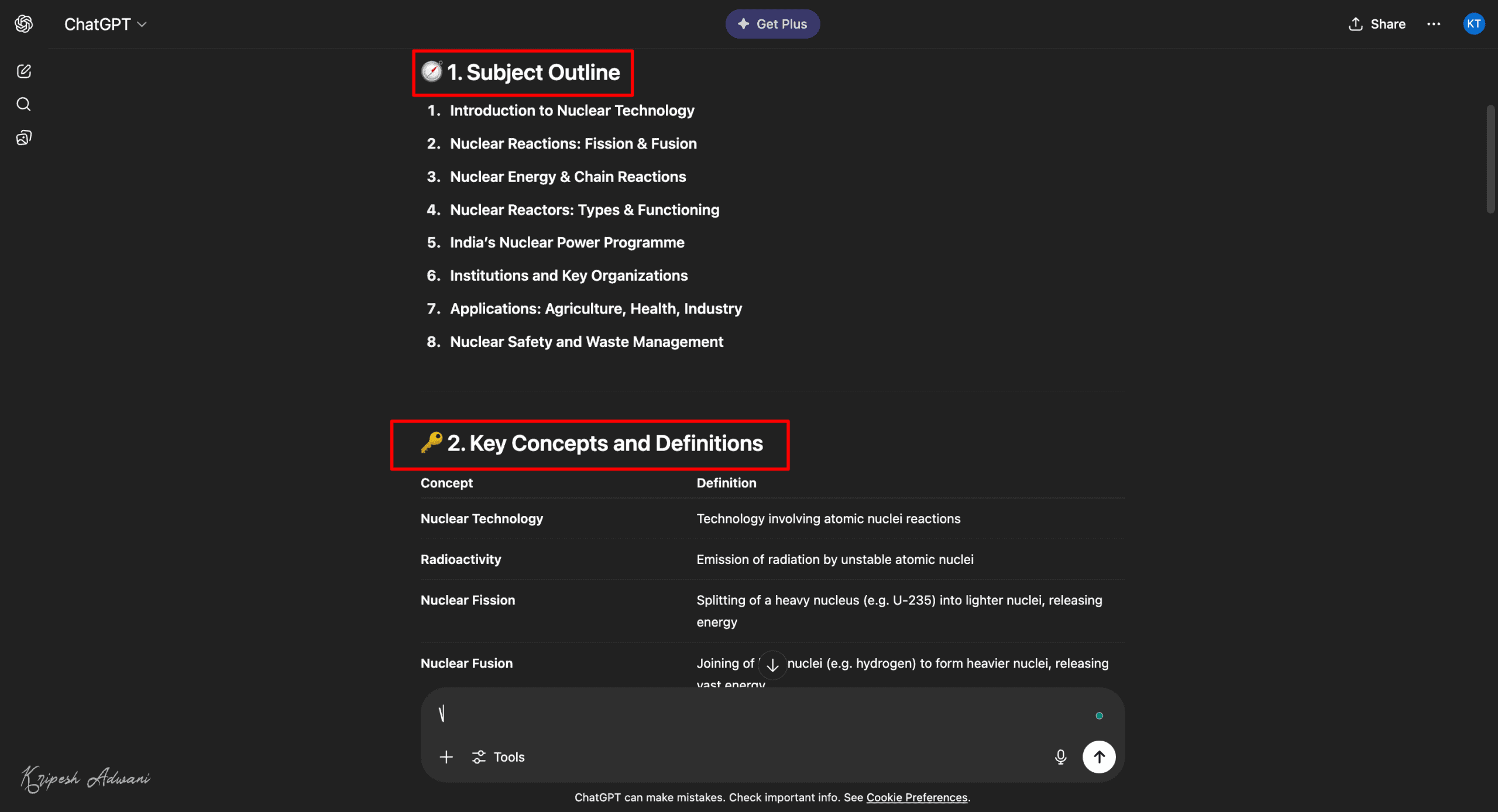
ChatGPT can help organize your unstructured notes into a clear, bullet-point format. You can paste links or URLs or upload PDFs, and ChatGPT will break them down into digestible summaries or key points.
For example, I uploaded my lecture notes and asked ChatGPT to create a study guide, summary, key concepts, and even practice questions. It worked like magic!
Here’s the prompt I used:
Prompt
Here is my lecture note on Nuclear Technology. I’m a 2nd-year undergraduate student in India. Give me a study guide for Nuclear Technology. It should include a clear outline of the subject matter, key concepts and definitions, relevant examples, practice questions, and summaries of important information.Sample Prompt Template:
Prompt
Here is my [insert assignment type] on [insert topic]. I’m a [insert your standard] student in India. Give me a study guide for [insert topic]. It should include a clear outline of the subject matter, key concepts and definitions, relevant examples, practice questions, and summaries of important information.Output:
B. Summarizing Textbooks, Lectures, and Articles
You can also upload long pieces of text and have them converted into concise notes that are perfect for revision. ChatGPT can summarize textbook content, provide topic recaps for students, and generate TL;DR summaries for articles, blogs, or research papers.
Prompt
Summarize Electrostatics for a Class 12 ISC Physics student. Include key themes, essential concepts, important definitions, exam-relevant diagrams (if any), and notable trends or patterns to support understanding and revision.
Sample Prompt Template:
Prompt
Summarize [insert topic] for a [grade level] [insert subject] student. Include key themes, essential concepts, important definitions, exam-relevant diagrams (if any), and notable trends or patterns to support understanding and revision.Output:

C. Clarifying Difficult Concepts
Need help to understand a tough science concept? ChatGPT can help with that, too!
AI tools can break down complex topics into everyday language or connect abstract theories to real-life scenarios. For example, explaining electricity flow as water flowing through pipes makes it much easier to grasp.
Here’s how I used ChatGPT to break down a challenging topic, Quantum Computing, with the help of real-life examples and analogies:
Prompt
I need to study a complex topic, Quantum Computing, but my understanding is limited. Please break it down into smaller, easy-to-understand parts using bullet points. Include key concepts, simple analogies, and real-life examples to make the topic more relatable and easier to grasp.
Sample Prompt Template:
Prompt
I need to study a complex topic, [insert topic], but my understanding is limited. Please break it down into smaller, easy-to-understand parts using bullet points. Include key concepts, simple analogies, and real-life examples to make the topic more relatable and easier to grasp.Output:

D. Exploring Multiple Perspectives
If you really want to build critical thinking skills, it’s important to look at a topic from different angles. This is especially useful for students in college, university, or even at the PhD level, where surface-level understanding just isn’t enough.
For example, when I was trying to get a deeper understanding of digital marketing, I wanted to see how it works in real-world roles, like in business strategy, content creation, or data analysis.
So I used a prompt like this:
Prompt
I’m an undergraduate student studying digital marketing. Help me explore the subject from different perspectives. Break it down from the viewpoints of a business strategist, content creator, data analyst, and consumer psychologist. Explain how each role contributes to digital marketing and highlight the key questions or challenges they typically focus on.
Sample Prompt Template:
Prompt
I’m a [mention your grade] student studying [research topic]. Help me explore this subject from different perspectives. Break it down from the viewpoints of [target audience/perspectives]. Explain how each role contributes to [insert topic], and highlight the key questions or challenges each typically focuses on.Output:

E. Mock Interview
College students preparing for internships can also benefit from ChatGPT. Simply define your goal, the type of exam or interview, and the job role you’re applying for, and ChatGPT will help you plan effectively, save time, and prepare through mock interview simulations.
Here’s a sample prompt I used:
Prompt
I’m interviewing for a Technical Copywriter role at IBM. I have 2 years of experience in reviewing AI tools, creating SaaS product tutorials, and writing SEO-optimized technical blogs and articles. What technical aspects should I prepare for in the interview? Please provide a list in order of importance.”
Sample Prompt Template:
Prompt
I’m interviewing for a [insert job role] role at [insert company name]. I have [mention experience level] in [mention skills]. What technical aspects should I prepare for in the interview? Please provide a list in order of importance.Output:

F. Viva Preparation
If you’re a student preparing for an oral exam, you can ask ChatGPT to act as an examiner and simulate a question-and-answer session for practice.
Here’s a similar example:
Prompt
I’m a final-year university student preparing for my viva exams on a project based on Indian Mythology, titled ‘The Significance of the Kurukshetra War.’ Assume the role of a university examiner and ask me both common and critical questions I should be ready for. Please provide feedback after each of my responses.
Sample Prompt Template:
Prompt
I’m interviewing for a [insert job role] role at [insert company name]. I have [mention experience level] in [mention skills]. What technical aspects should I prepare for in the interview? Please provide a list in order of importance.Output:

Use Case 2: Subject-Specific Study Strategies
A. Studying STEM Subjects (Math, Physics, Computer Science)
You won’t always have a tutor by your side to help with math or coding doubts. And that’s where ChatGPT can really make a difference.
It can guide you through step-by-step problem-solving, offer quick formula or definition recaps, assist with code debugging and writing, and even generate custom practice problems for you.
For Math Help
Instead of using ChatGPT, we’ll use custom GPTs built specifically for educational use. One great example is “Math” by pulsrai.com, a custom GPT designed for solving math problems. With custom GPTs, you don’t even need to write detailed prompts. Just copy and paste your question, and it handles the rest.
Here’s my prompt:
Prompt
Solve this algebraic equation and give me the proper workings: If f(x) = (4x+3)/(6x-4), x ≠ 2/3, show that f(f(x)) = x for all x ≠ 2/3. What is the inverse of f?
Sample Prompt Template:
Prompt
Solve this algebraic equation and give me the proper workings: [insert math problem]Output:

For Coding
We’ll use a custom GPT called Code Copilot, developed by promptspellsmith.com. It’s designed to assist with code writing, bug fixing, data visualizations, and more. Code Copilot works well in both Canvas and Python modes.
Let’s say I was struggling to understand a Python code. I used the following prompt to simplify the logic:
Prompt
I couldn’t understand this Python code:

[def is_even(n):

    binary_repr = bin(n)

    return binary_repr[-1] == ‘0’]

Can you explain its logic in simpler terms?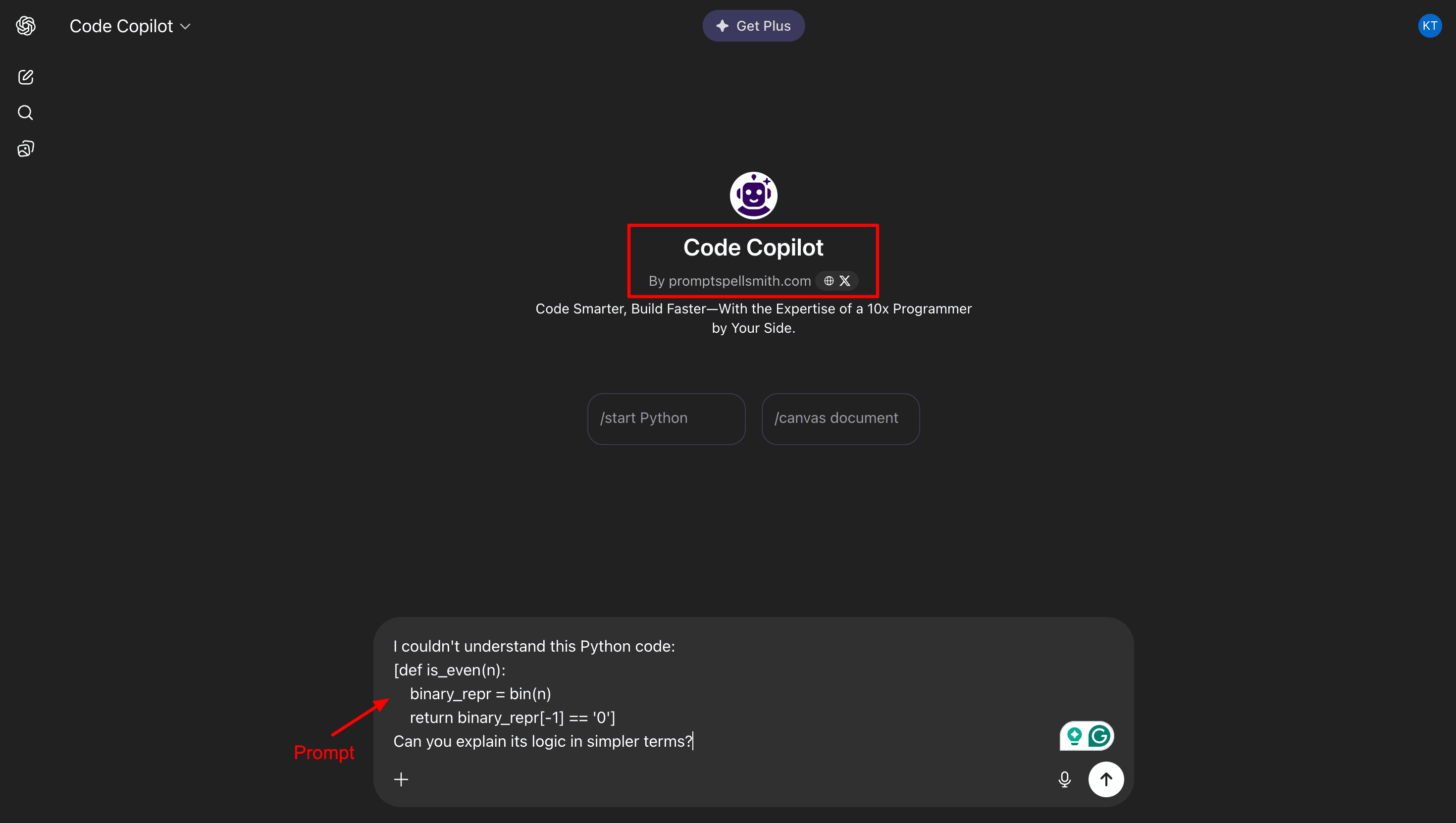
Sample Prompt Template:
Prompt
I couldn’t understand this Python code: [insert code]. Can you explain its logic in simpler terms?
Output:

B. Essay Brainstorming
Students often get stuck either choosing the right essay topic or organizing their thoughts into a clear structure. So, they can use ChatGPT to generate topic ideas, create a structured outline, conduct basic research, and even get suggestions for thesis statements.
Let’s say I want to write an argumentative essay for a biology-related topic. Here’s the prompt I used:
Prompt
I’m preparing to write an argumentative essay and need help with brainstorming and research. Please help me refine my topic “Should BMI be removed as a required measure of health?” or suggest relevant ideas, identify key questions or perspectives to explore, recommend reliable sources or research materials, and suggest a clear outline or structure. The essay is for high-school students, on the subject of Science, and should be around 1500 words.
Sample Prompt Template
Prompt
I’m preparing to write an argumentative essay and need help with brainstorming and research. Please help me refine my topic [insert topic] or suggest relevant ideas, identify key questions or perspectives to explore, recommend reliable sources or research materials, and suggest a clear outline or structure. The essay is for [insert level], on the subject of [insert subject], and should be around [insert word count].Output:

C. Mastering Language Learning
For Grammar and Vocabulary
ChatGPT can help build vocabulary, proofread writing, correct grammar errors, and even assist with vocabulary practice and pronunciation. I want to practice English-to-Hindi vocabulary. I also need help to refine my accent and improve my pronunciation.
Here’s the prompt I used:
Prompt
Create an English-Hindi vocabulary list for daily conversations suitable for a university student. Include Hindi translations along with transliterations for easier pronunciation. Also, provide guidance on the correct English pronunciation for each word or phrase to help me speak more clearly and confidently.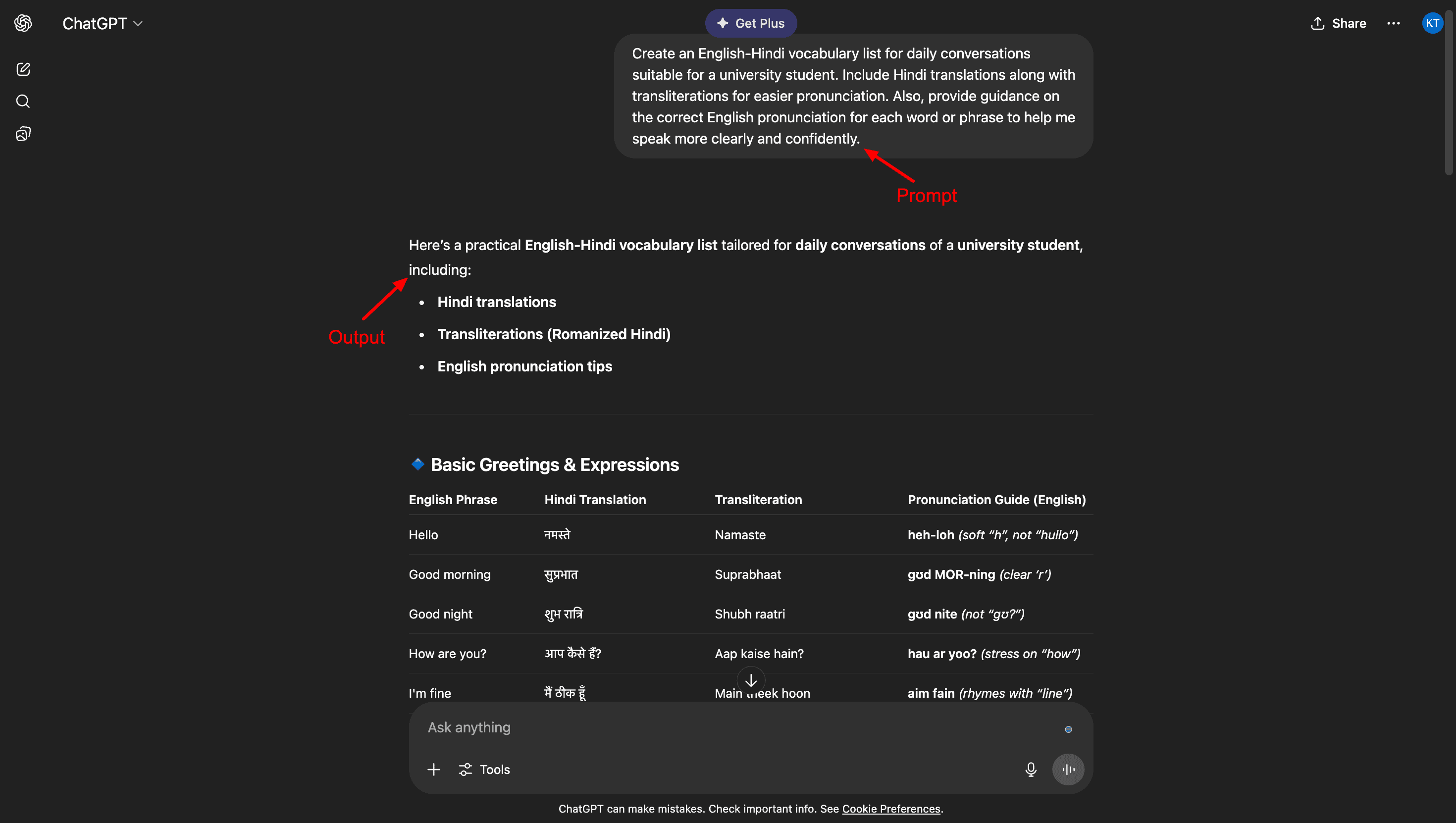
Sample Prompt Template:
Prompt
Create a [mention source-to-target vocabulary language pair] vocabulary list for daily conversations suitable for a [mention learning level]. Include [mention target language] translations along with transliterations for easier pronunciation. Also, provide guidance on the correct English pronunciation for each word or phrase to help improve clarity and confidence in speaking.Output:

For Conversation Practice

Again, we’ll use a custom GPT, English Speaking Practice GPT, for this activity. It allows you to have conversations with AI for speaking practice. You can type or record your responses, and it will automatically transcribe them and provide feedback with suggestions for improvement.

Use Case 3: Advanced Study Techniques
A. Research Help & Literature Reviews
I often use ChatGPT to generate easy-to-digest points for lengthy lecture notes. For more in-depth research, I suggest turning on “Run deep research” from the tools under the chat dashboard. It’ll be better to write a detailed prompt mentioning the topic, purpose of research, and other details.
For example, I used the following prompt to research Quantum Mechanics.
Prompt
I’m a final-year undergraduate Physics honors student in India. Help me research recent discoveries and advancements in Quantum Mechanics (focusing on developments from 2020 to 2025). Structure the response for an academic audience and align it with the Indian undergraduate curriculum.

Include the following sections: Overview of Quantum Mechanics Key principles and mathematical foundations, Recent Developments (2020–2025), Advances in quantum computing, communication, and simulation, Latest experiments (e.g., Bell test, quantum supremacy), India’s role (e.g., Quantum Mission, ISRO initiatives), Current Challenges and Open Questions, Further Learning Resources, Recommended books, lectures, research papers.
Sample Prompt Template:
Prompt
I’m a [mention your academic year and subject] student in India. Help me research [mention your research topic]. Structure the response for an academic audience and align it with the Indian undergraduate curriculum. Include the following sections: [mention key points or subtopics you want covered].Output:

B. Creating Personalized Study Plans
You can use ChatGPT to create a personalized study plan. It’s helpful to mention the duration, specific topic, and any additional requirements. You can even request break schedules to ensure complete time management.
Example Prompt I Used:
Prompt
Create a customized 4-week study plan to help me prepare for and absorb Quantum Mechanics more effectively. Break down the study sessions by topic, include time for breaks and review, and suggest additional books and websites that simplify complex concepts.
Prompt
Create a customized [mention duration/timeline] study plan to help me prepare for and absorb [mention study topic] more effectively. Break down the study sessions by topic, include time for breaks and review, and suggest additional books and websites that simplify complex concepts.Output:

C. Preparing for Exams and Quizzes
To speed up exam preparation, I recommend using ChatGPT to generate multiple-choice questions for quizzes that test your understanding, create exam-style papers based on previous years’ formats, review your written answers, and more.
For example, I asked ChatGPT:
Prompt
Create 20 multiple-choice exam questions with 5 answer options each. The MCQs should be at the Joint Entrance Examination (Main) level. Provide explanations for each answer along with the questions and present the answers in a tabular format.
Prompt
Create [number of questions] multiple-choice exam questions with [mention number of answer options] answer options each. The MCQs should be at the [mention examination level] level. Provide explanations for each answer along with the questions and present the answers in a tabular format.Output:

Use Case 4: Visual Learning with ChatGPT
A. Creating Flowcharts
Flowcharts help students organize their thoughts in a clear and structured way. They are especially useful for understanding and remembering complex topics in subjects like literature or science.
I took the help of the custom GPT, Presentation & Diagram Generator by <ShowMe>. Here’s how I used it to simplify a topic in Indian Polity with the following prompt:
“Break down the process of how a Bill is passed and becomes an Act in India into simple, step-by-step instructions. Create a flowchart and suggest other effective methods to help me memorize it quickly.”

Prompt
Break down the process of [enter topic] into simple, step-by-step instructions. Create a flowchart and suggest other effective methods to help me memorize it quickly.Output:

B. Making Flashcards for Memorization
Flashcards contain a key term or question on one side and the most important information or answer on the other. This makes studying more engaging and fun, especially for quick revisions. You can use ChatGPT to easily generate questions and create flashcards in minutes.
For example, I used this prompt:
Prompt
I‘m a 2nd-year Anthropology Honours undergraduate student preparing for an upcoming test on the Study of Human Population. I need flashcards to help me memorize important concepts and details.
Sample Prompt Template:
Prompt
I’m a [mention grade and level] undergraduate student preparing for an upcoming test on [enter topic]. I need flashcards to help me memorize important concepts and details.
Use Case 5: Smart Mentorship
A. Personal Tutoring
Instead of relying on ChatGPT just for studying or writing help, you can treat it as your personal tutor. It can ask you questions one by one, give feedback, and encourage active learning. This creates an engaging, thought-driven session rather than just spoon-fed answers.
Let’s take an example:
Prompt
I’m trying to understand how quantum entanglement works. Please guide me step by step without giving the full explanation upfront—ask me questions along the way to test my understanding.
Sample Prompt Template:
Prompt
I’m trying to understand [enter topic]. Please guide me step by step without giving the full explanation upfront—ask me questions along the way to test my understanding.
B. Fact-Checking & Verifying Information
The ChatGPT Search Tool is uniquely designed to provide answers with web links and credible sources. It’s especially useful for fact-checking and verification, promoting media literacy, and encouraging users to validate information using trustworthy references.
For example, I used this prompt to verify a claim about AI:
Prompt
I found this claim online: ‘AI tools will replace 80% of human jobs by 2030.’ Can you help me fact-check this and suggest reliable sources or reports I can refer to?
Sample Prompt Template:
Prompt
I found this claim online: [enter statistic or claim]. Can you help me fact-check this and suggest reliable sources or reports I can refer to?Output:

C. Maintaining Critical Thinking
Suppose you’re taking part in a debate competition. In such cases, critical thinking is essential—you need to analyze issues and build well-structured, constructive arguments. This is where ChatGPT encourages critical thinking by helping you consider multiple perspectives on a topic.
How? Example Prompt I Used:
Prompt
Some say AI is revolutionizing education, while others argue it diminishes natural human thinking abilities. Can you help me construct arguments for both sides of this debate?”
Sample Prompt Template:
Prompt
[Enter debate statement/topic]. Can you help me construct arguments for both sides of this debate?Output:

Sample ChatGPT Prompt Library for Students
| Use Cases | Prompt |
| Structure unorganized notes | Clean up these lecture notes and turn them into clear, bullet-point study notes. |
| Turn notes into study Guides | Convert these notes into a study guide. |
| Convert the document to a presentation | Turn this document into a script for a presentation. |
| Key terms for Science/Literature subjects | List and define the 5–7 most important terms I need to understand [enter topic, e.g., Newton’s Laws]. |
| Research source | List some peer-reviewed or official sources I can cite for [enter topic]. |
| Literature review | Give me a brief literature review on [topic], summarizing key studies and debates. |
Conclusion
In this article, I explored different ways to use ChatGPT for studying across different levels, from junior students and high school learners to college researchers and scholars. I highlighted practical use cases and tailored prompts to make the most of this AI tool in academic settings.
Using these prompts can help you save time, make smarter use of study resources, and focus your efforts on more meaningful learning. Try experimenting with the prompts and feel free to customize them to suit your personal study needs.
If you’d like a prompt library for another topic, just let me know. Until then—happy studying!
FAQs
Can ChatGPT help me study for exams?
Absolutely! ChatGPT can assist you with personalized study plans for individual subjects. You can solve math problems, learn to code, improve grammar and vocabulary, and much more.
Is it okay to use ChatGPT for homework assignments?
Yes, you can use ChatGPT as a learning aid to manage your time more effectively. However, avoid copying and pasting numerical problems or using ChatGPT to write entire assignments. It’s best used as a tool to support your own learning.
How can ChatGPT improve my writing and grammar?
OpenAI’s ChatGPT can suggest vocabulary, help you learn English more effectively, and act as a proofreader to identify and correct errors in your writing. You can also use it to create outlines, refine drafts, and adjust tone and style.
Can ChatGPT help with technical subjects?
Yes! ChatGPT can support learning in subjects like computer science, physics, and other technical fields. There are even custom GPTs specifically designed for more advanced technical assistance.
Is ChatGPT free for students?
Yes, OpenAI offers a free version of ChatGPT that provides access to the basic model. For access to more advanced features and smarter responses, there’s also a paid version called ChatGPT Plus.


